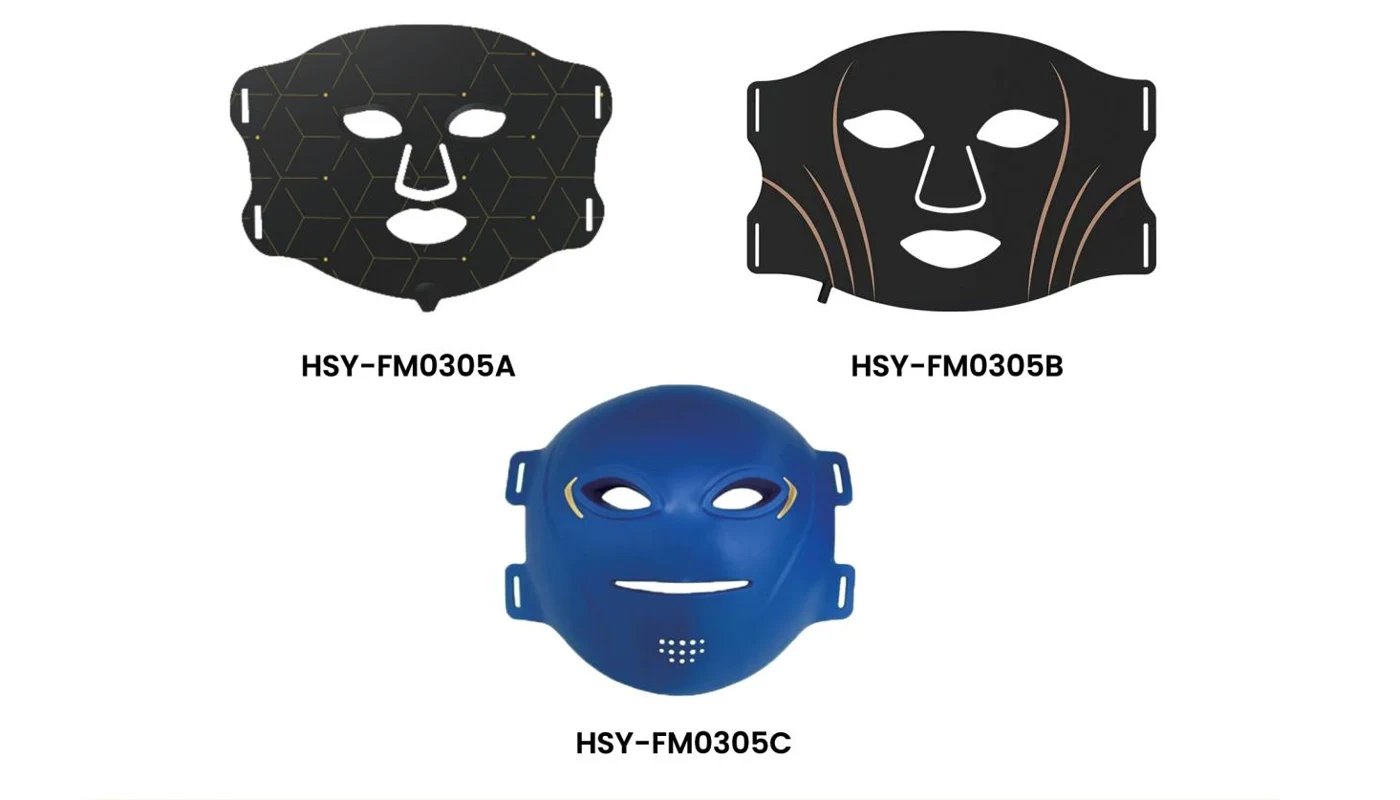
An LED face mask OEM project needs a defined fit, light configuration, control sequence and evidence file before branding is approved. A catalogue image can help shortlist a format, but it cannot show whether the finished mask fits the intended users or supports the proposed marketing claims.
HSY's knowledge base includes silicone LED masks within its beauty and home-care range and describes customization of materials, light configurations, controls and packaging. This guide uses the supplied catalogue to structure the next step: a sample that your product team can evaluate against written requirements.
01 — Catalogue comparison
Keep each mask's listed parameters together
PDF page 12 presents HSY-FM0305A, HSY-FM0305B and HSY-FM0305C. The table below transcribes their listed wavelength entries and dimensions. Values belong to their respective columns; do not combine one model's spectrum with another model's size to describe an unconfirmed product.
| Model | Listed wavelengths | Listed dimensions |
|---|---|---|
| HSY-FM0305A | 460 / 520 / 590 / 630 nm | 295 × 218 × 5.3 mm |
| HSY-FM0305B | 460 / 520 / 590 / 630 nm | 300 × 215 × 5.3 mm |
| HSY-FM0305C | 465 / 590 / 630 / 850 nm | 298 × 217 × 5.3 mm |
The brochure lists 460 nm for A and B and 465 nm for C; that distinction is retained here. Ask for a current specification and spectral verification for your selected version. These dimensions describe catalogue entries, not a tested fit range or the size of the illuminated area.
The same page lists six skincare modes, brightness adjustment and a pulse function. A mode count does not establish six separate wavelengths, nor does it explain the channel combinations or timing behind each mode. Request that mapping explicitly.
02 — Fit and construction
Evaluate openings, straps and cable routing
Define the intended user group and how the mask will be positioned and removed. Ask for drawings showing the eye, nose and mouth openings, strap attachments and connector location. Identify the material and construction of the proposed sample instead of assuming every pictured mask uses the same design.
Arrange a fit assessment against a written procedure for the intended user range. Record whether the mask shifts, where it contacts the face, whether straps can be adjusted consistently and how the controller is reached. Keep this assessment separate from any evaluation of treatment effectiveness.
Clarify whether a quoted dimension refers to a flat component, assembled product or another measurement condition. If the supplier proposes a neck accessory or an alternative mask format, review that assembly separately. Page 13 shows additional face and neck formats; their dimensions and controls should not be transferred to the page 12 models.

03 — Light configuration
Ask how wavelengths and operating modes are verified
For the selected model, request the nominal wavelength of each channel, the enabled combinations and the control settings used during measurement. Ask for the spectrum and output records associated with that configuration. The catalogue table does not establish the output contribution of each listed wavelength.
Specify a measurement arrangement that reflects the proposed mask geometry, with locations, instrument, settings and positioning recorded. An irradiance figure without its measurement conditions is difficult to compare. If a mask changes shape when fastened, ask how that geometry is represented in the evaluation.
Do not infer exposure duration or a treatment programme from the number of modes, the wavelength list or a product photograph. Those decisions need the relevant product evidence and review. This article does not recommend a dose or promise an effect on a skin condition.
04 — Controls and care
Write the operating sequence before approving packaging
Prepare a function list that describes starting, selecting a mode, changing brightness, stopping and restarting. For the pulse function, ask the supplier to define the available settings and expected indication. Confirm whether the product remembers a previous setting and what the user sees when operation ends.
The knowledge base mentions smart controls within HSY's broader OEM/ODM services. An app, Bluetooth connection or voice feature should be individually specified and quoted; it is not established as standard for these masks by that service description.
Request the cleaning method for the mask surface, straps, controller and connector. Ask what must be disconnected, which products or processes are permitted and how the device should dry. Agree a repeat-cleaning assessment and recheck appearance and function afterward. Avoid “washable” or “waterproof” wording unless the exact construction has supporting documentation.
Check how the mask, controller, cable and instructions fit inside the retail package. Have evaluators follow the draft instructions when unpacking and storing the sample. The exercise can expose unclear component names, awkward cable storage or illustrations that no longer match the approved revision.
05 — Claims and documentation
Separate a product specification from a claim of effectiveness
A wavelength, mode name or catalogue illustration does not establish a therapeutic outcome. Make a list of the claims proposed for the box, website and manual, then ask which evidence relates to the exact device and intended use. Keep supplier marketing statements separate from independently verified results.
For U.S. documentation, the FDA explains that establishment registration and device listing do not denote approval, clearance or authorization. This is a document-checking distinction, not a statement about the regulatory status of any mask shown here.
Request the holder, model identifiers and scope of any report or authorization being offered. A document for a different model should not be treated as evidence for your customized mask. Record the approved labels, manual and specification together so later changes can be assessed against a clear baseline.
06 — Buyer questions
Questions before an LED mask purchase order
Are six modes the same as six wavelengths?
No such equivalence is established by the catalogue. Request the channel combination and control behaviour of every mode.
Can the listed dimensions establish universal fit?
No. Confirm the dimension definition and evaluate the actual construction, openings and adjustment range for the intended users.
Can one model's documentation cover another mask?
Check the document's identified models and scope. Do not assume coverage from a similar appearance or shared product family name.
Sources and next step
Send a mask brief with clear acceptance criteria
Share your selected format, intended user group, target market, channel requirements, controls, materials, quantity and packaging needs. Explore HSY's beauty device category, review the OEM/ODM scope, and request a sample proposal with model-specific documents.
Product sources: the supplied HSY company catalogue, PDF pages 12–13, and company knowledge notes on products, applications, customization, quality and unverified claims. The table uses page 12 manufacturer-listed entries, not independent test results. Images are catalogue illustrations. This article is an OEM procurement guide, not treatment advice or an assessment of clinical efficacy.