The global market for red-light-therapy hardware keeps expanding. DTC wellness brands, med-spa operators, e-commerce sellers and veterinary product companies all need manufacturing partners that can turn product concepts into sellable inventory without sacrificing quality, compliance or delivery predictability.
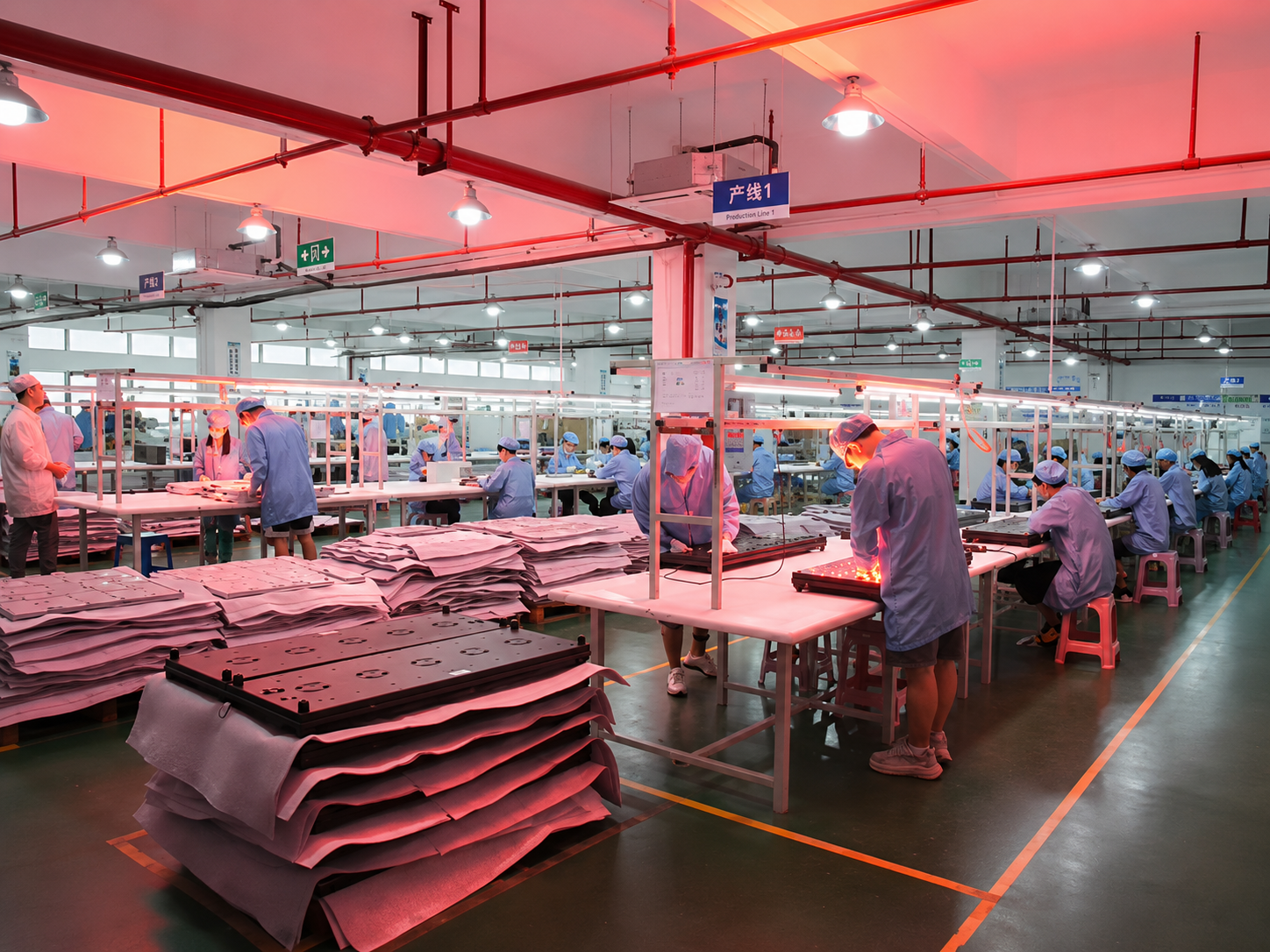
For Shenzhen-based LED health-device manufacturer HSY Technology, product-focused operations have supported growth since 2017. Over nearly a decade, the factory has built product lines for human recovery, beauty care and animal-use red-light applications while supporting wholesale, private-label OEM and full-scope ODM development.
This article shares practical lessons from red-light-therapy hardware operations. It covers product portfolio management, OEM and ODM workflows, quality-control guardrails, cross-border compliance risk and channel-oriented product adaptation for brand buyers and manufacturing operators.
Scalable manufacturing depends on matching each customer segment to the right product, customization depth, evidence requirements and commercial terms before development starts.
01 — Portfolio strategy
Segment human, beauty and veterinary use cases
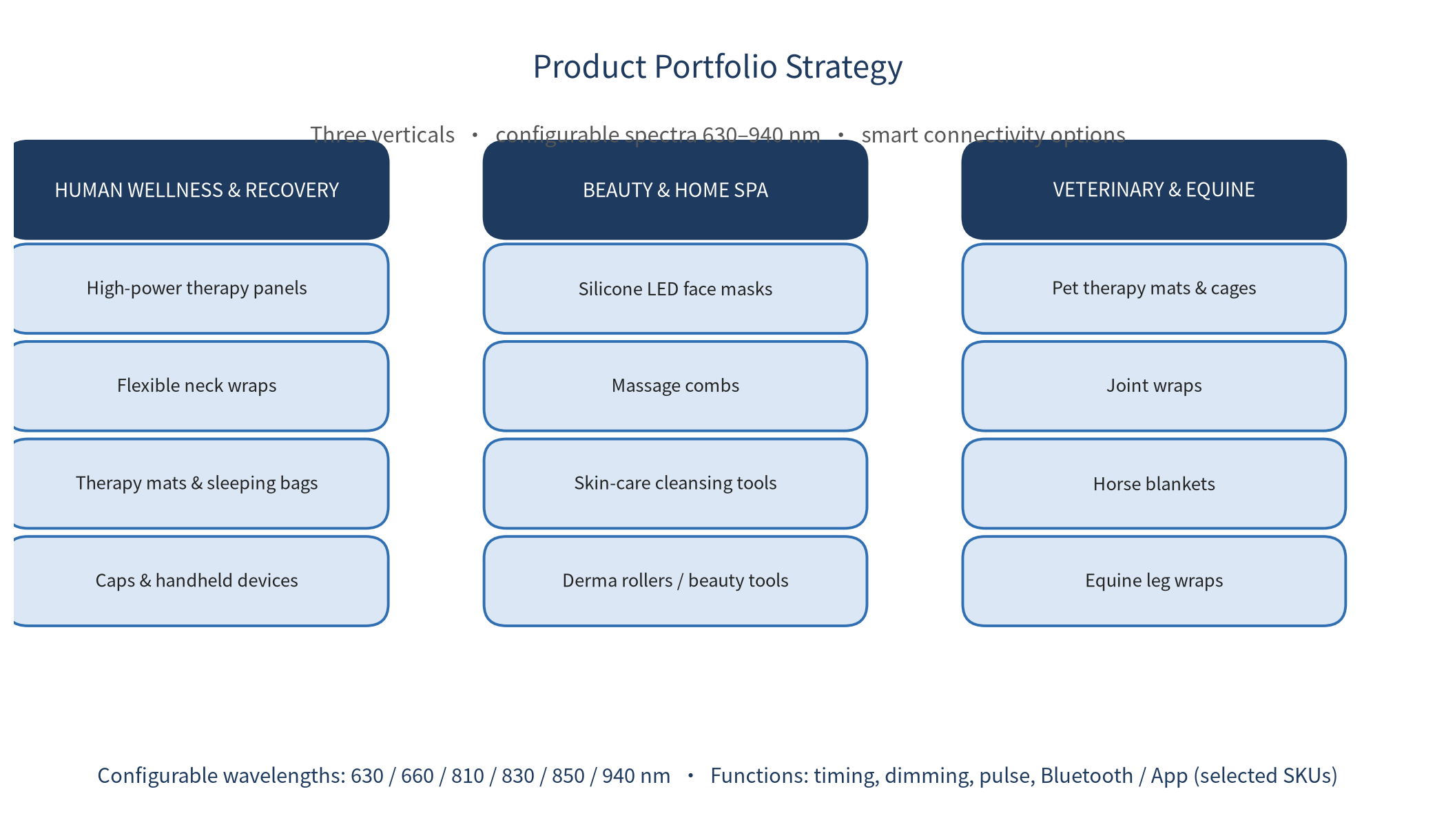
Avoid one-size-fits-all. Effective B2B hardware operations start by separating distinct use cases. HSY organizes its portfolio into three major verticals: human health and physical recovery, beauty and spa equipment, and veterinary and equine photobiomodulation products.
The human wellness lineup includes high-power therapy panels, flexible neck wraps, therapy mats, sleeping bags, caps and compact handheld torches. The beauty segment includes silicone LED face masks, massage combs and skin-care tools. The veterinary range spans pet therapy mats, therapy cages, joint wraps, horse blankets and equine leg wraps.
Products can support configurable wavelength combinations across 630, 660, 810, 830, 850 and 940 nm. Selected SKUs also offer timing, dimming, pulse modes and smart connectivity such as Bluetooth or app control. Buyers should confirm the exact configuration available for each model.
Different segments bring different expectations
- E-commerce resellers prioritize ready-to-ship stock, competitive wholesale minimum order quantities and FBA-ready packaging.
- Start-up brands want low-risk trial orders, private-label logo and packaging changes, and clear compliance documentation for target markets.
- Clinical and med-spa buyers expect stable optical performance, traceable quality records and relevant certification files.
- Veterinary brands require mechanical designs suited to animal-safe use, not simply repurposed human-use hardware.
Product teams should map each customer persona to suitable SKUs, customization depth and commercial terms. This reduces misaligned expectations during early inquiry handling. Buyers can review HSY's current product lines before preparing a request.
02 — OEM and ODM workflow
Use a structured workflow to reduce project risk
Discipline beats improvisation. Custom development can be high-margin, but it also creates schedule, rework and regulatory risk. A defined operating process keeps OEM and ODM projects aligned with the buyer's intended market.
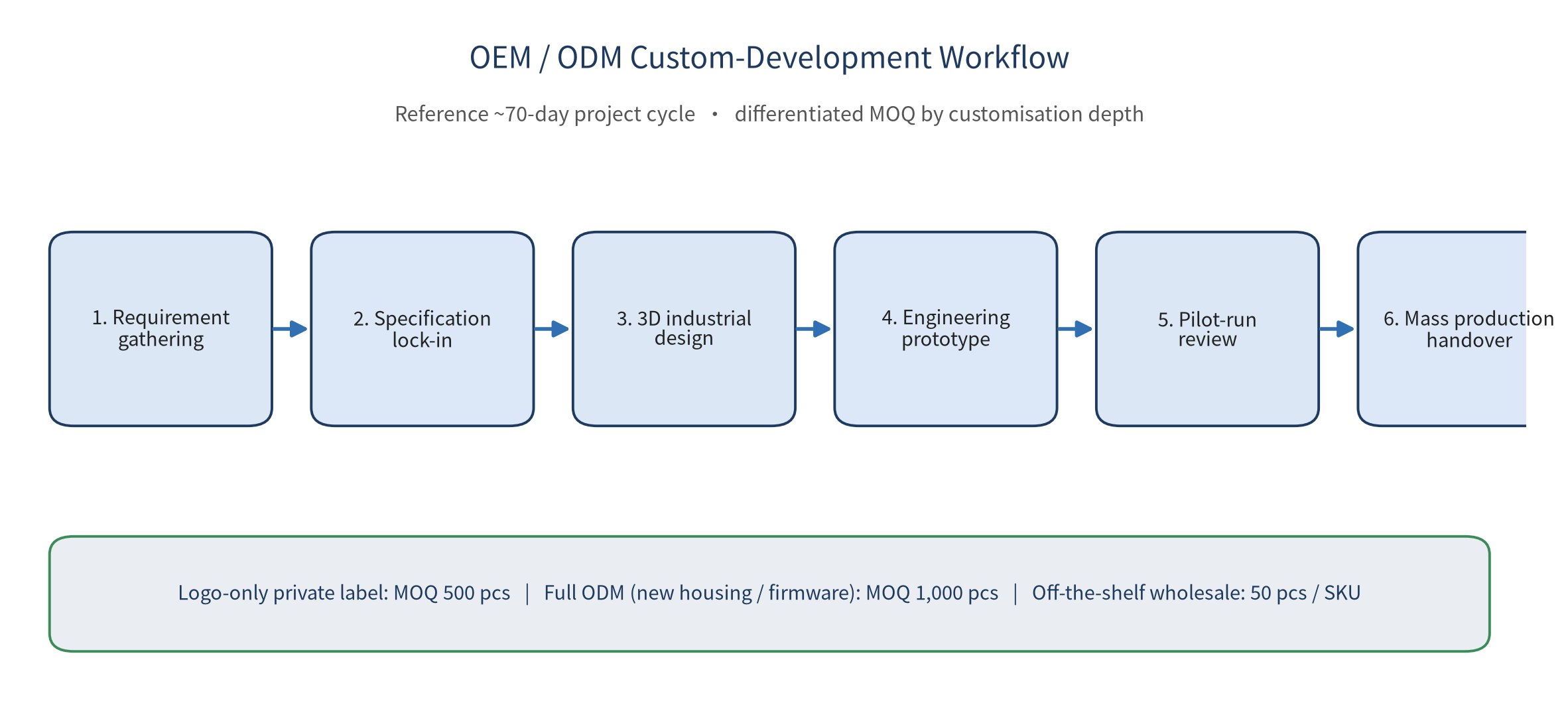
HSY publishes a reference 70-day cycle for full custom development. It covers requirement alignment, specification lock-in, 3D industrial design, engineering prototype validation, pilot-run review and mass-production handover. This is a benchmark rather than a fixed lead time; mould work, feature complexity and certification needs can change the schedule.
A critical guardrail is standardizing the information collected before quotation. The product team needs the target sales region, intended application, hardware format, wavelength and irradiance targets, control features, branding and packaging needs, order volume, target unit cost, delivery timeline and mandatory import-market evidence.
Minimum order thresholds also vary by scope. HSY's published reference terms start at 500 units for logo-and-packaging-only OEM work, 1,000 units for full ODM involving new housing or firmware, and 50 pieces per SKU for off-the-shelf wholesale. Pilot trial orders may be accepted for qualified partners after project evaluation.
Separating light private-label changes from ground-up ODM development helps prevent scope creep. HSY's OEM and ODM process explains the stages buyers should define before quoting.
03 — Quality operations
Build quality control around the production flow
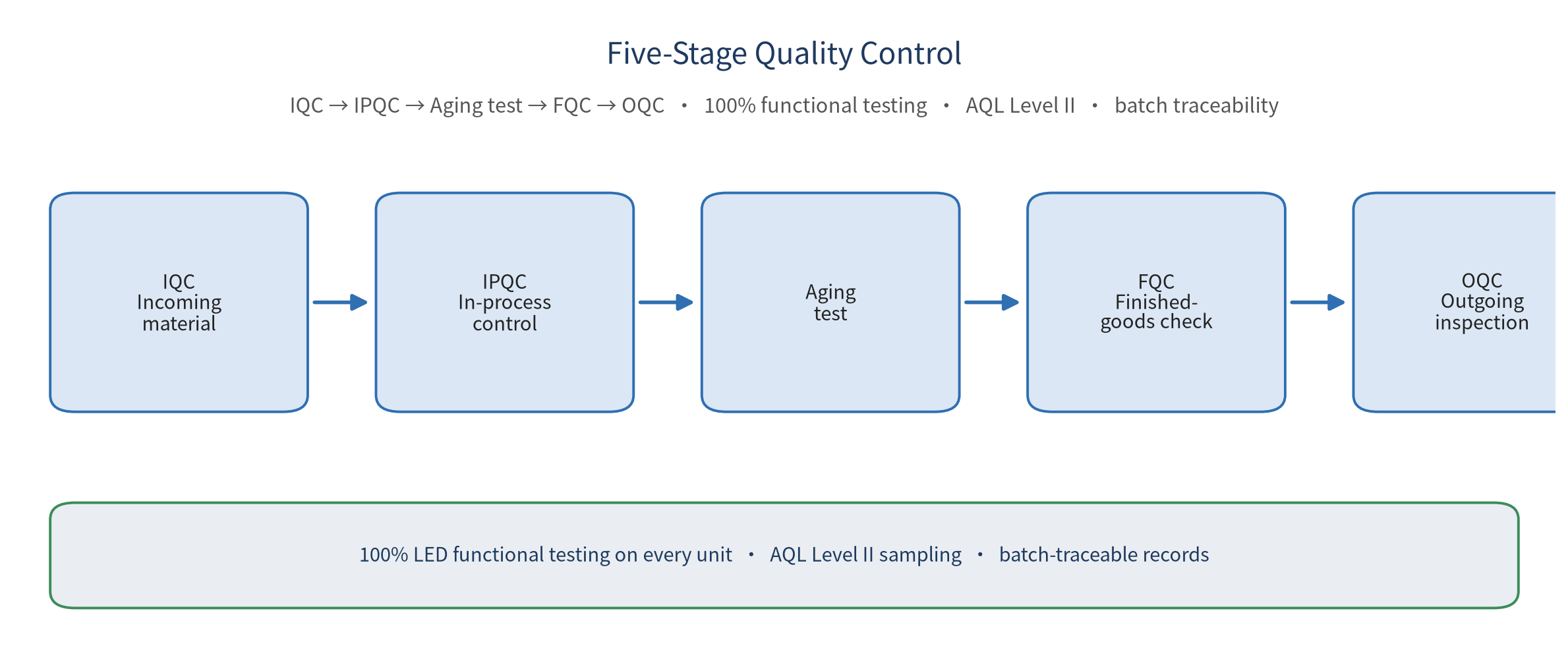
Product-led operations require dependable quality assurance. HSY describes a five-stage internal system: incoming material control (IQC), in-process quality control (IPQC), equipment aging testing, final finished-product checks (FQC) and outgoing quality control (OQC).
Units undergo 100% functional testing for LED output, mode switching and controller behavior. Inspection follows AQL Level II sampling standards, with batch traceability maintained across production runs.
Certification claims need model-level verification
HSY's public-facing materials list certifications and registrations including CE, FCC, RoHS, UL or ETL, ISO 9001:2015, ISO 13485 and FDA-related records. A certification name on a website does not mean every product model carries every listed credential.
Operators and buyers should verify the certificate holder, model scope, referenced standard, issue date and validity before import or sale. ISO system certifications describe processes; they do not prove medical-grade performance or therapeutic efficacy. FDA registration is also distinct from FDA clearance or approval.
Warranty coverage varies by model. Certain pet-focused SKUs list one year, mainstream consumer models list 24 months, and selected high-power panels list three years. The purchase contract—not general website copy—defines the binding warranty. Review the site's quality and compliance guidance and request evidence for the exact SKU.
04 — Cross-border operations
Align products, packaging and logistics for global buyers
The job continues beyond the factory. Export product operations extend to retail packaging, manual translation, label compliance and logistics coordination.
HSY supports Amazon FBA labeling and preparation, drop-shipping arrangements and DDP door-to-door delivery for major markets including the United States, Europe, Australia and Canada. Teams can also assist with commercial invoices, packing lists, certificates of origin and FDA prior-notice preparation.
Importers remain responsible for regulatory compliance, tariff classification, customs clearance and local product-safety rules in the destination market.
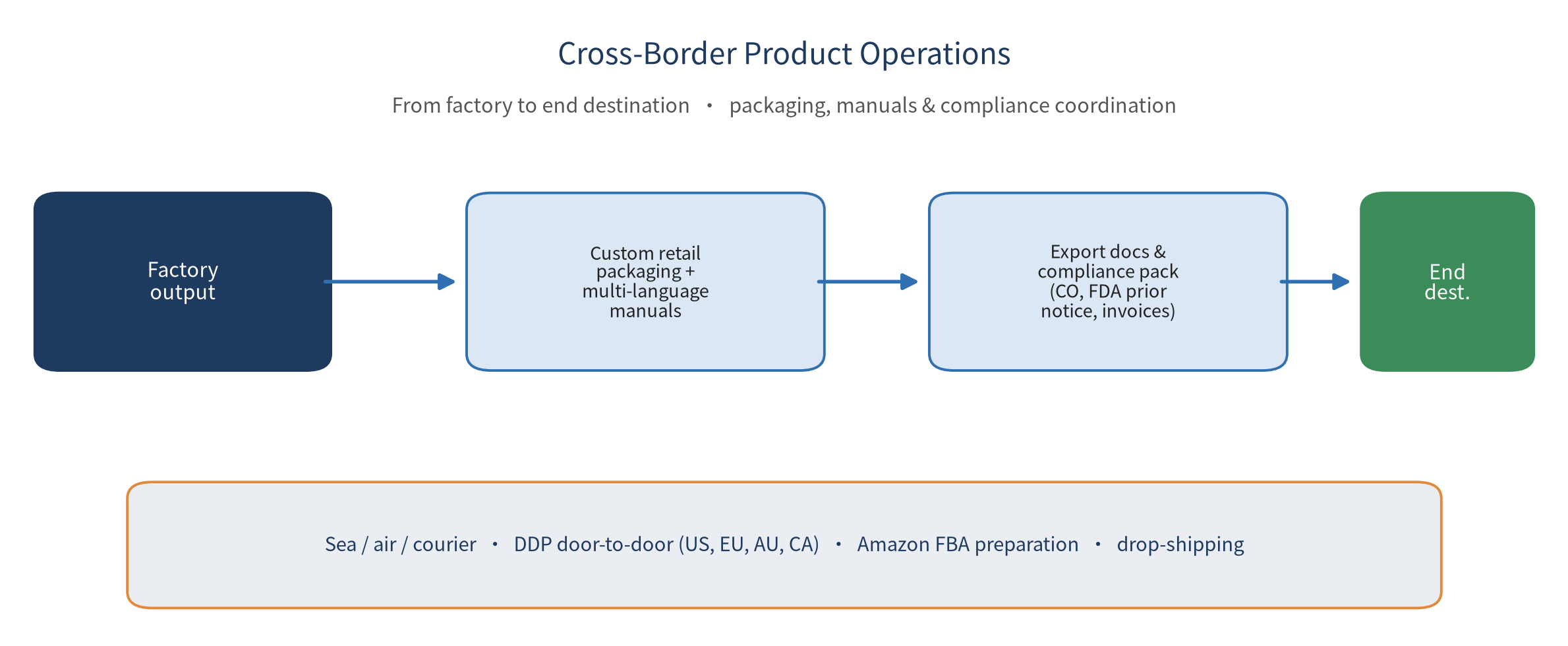
Wholesale pages describe reference terms such as 48-hour dispatch for spot inventory, 20–25-day lead times for customized orders, a 30% deposit with 70% due before shipment, and discounted sample pricing with possible sample-fee rebates on the first bulk order. These terms must be confirmed in a project-specific contract. See HSY's wholesale and logistics information for the current order-planning context.
05 — Operational takeaways
What manufacturers and brand buyers should do next
For manufacturing operators
- Segment the product portfolio by end-use vertical and customer persona instead of relying on generic offers.
- Standardize OEM and ODM requirement gathering to limit scope creep and reduce post-prototype rework.
- Treat published certification lists as summaries and verify evidence for each model before shipment.
- Include logistics and packaging within product operations rather than treating them as an after-sales add-on.
For brand buyers
- Clarify target-market regulatory requirements before requesting quotations.
- Distinguish logo-only private label from full ODM because order quantity, cost and timelines differ.
- Verify certification documents for the exact SKU instead of relying on supplier-page claims.
- Confirm warranty periods, aging-test standards and commercial terms in written contracts.
Conclusion
Reliable output is only one part of scalable manufacturing
Red-light-therapy hardware sits at the intersection of consumer wellness, medical-adjacent hardware and cross-border e-commerce. Successful manufacturing operations need structured portfolio segmentation, controlled custom-development workflows, rigorous quality governance and clear awareness of international compliance risk.
Manufacturers that embed compliance and customer-segment thinking into daily product operations can build more trustworthy, durable partnerships with global brands, distributors and clinical operators.
EEAT and disclosures
Source and verification notes
Experience: grounded in real factory operational workflows from HSY Technology's manufacturing practice. Expertise: focused on red-light-therapy OEM, quality control, certification risks and B2B hardware sourcing. Authoritativeness: structured operational analysis that separates reference information from binding contract terms. Trustworthiness: explicit caveats and separation of manufacturer-reported claims from independently verified facts.