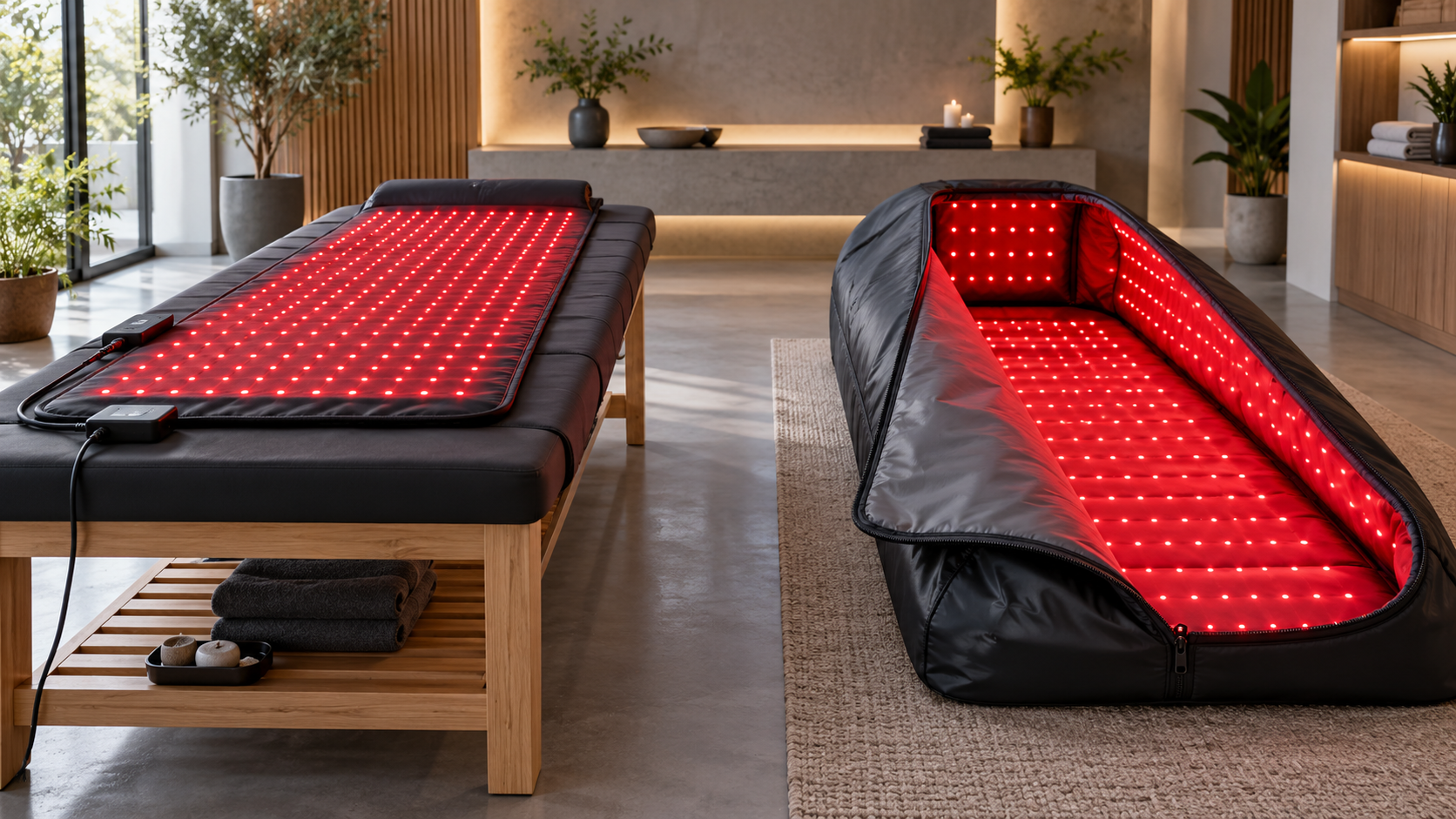
A flat red light therapy mat is usually the simpler first launch because it is easier to demonstrate, clean, fold and package. A sleeping-bag format can create a more immersive full-body experience, but it adds zippers, extra LED zones, more wiring and a more demanding thermal and durability validation plan. The right choice depends on the customer routine, target price, shipping limits and the level of product development your brand can manage.
Choose a mat when portability, simpler operation and a lower-complexity launch matter most. Choose a sleeping bag when wraparound coverage is central to the product promise and the brand can support the additional testing, packaging and after-sales requirements.
01 — Format
What is the practical difference between a mat and a sleeping bag?
A mat is a flexible LED surface designed to lie flat on a bed, floor or treatment table. The user lies on it or places it against a target area. Some designs can be folded or used as a loose wrap, but the product remains an open surface.
A sleeping bag uses two illuminated surfaces or a wraparound shell. The user lies between them and closes the sides with a zipper or another fastening method. This layout can expose the front and back of the body in one session, but the product contains more seams, conductors, connectors and contact surfaces.
| Decision factor | Flat mat | Sleeping bag |
|---|---|---|
| User experience | Open, familiar and easy to reposition | Enclosed and immersive with more setup steps |
| Coverage | One primary illuminated surface | Two-sided or wraparound coverage |
| Product complexity | Fewer seams, zones and power connections | More wiring, fasteners, zones and thermal interactions |
| Cleaning | Surfaces are easier to access | Interior surfaces and zipper areas require a clear protocol |
| Packaging | Usually thinner and easier to fold | Bulkier, heavier and more sensitive to fold pattern |
| Best first use case | Home wellness, studio or portable routine | Premium full-body recovery or spa-style positioning |
02 — Specification
Which specifications should buyers lock before comparing quotes?
A product name is not a specification. Two suppliers can both quote a “full-body mat” while proposing different dimensions, LED layouts, wavelength ratios, measurement methods and controller systems. Put the following items into the RFQ before comparing unit prices.
1. Product geometry and illuminated area
State the finished dimensions and the active illuminated area separately. For a sleeping bag, define the top and bottom panels, head opening, shoulder width, foot shape and zipper length. Ask the supplier for a dimensioned drawing and identify every area without LEDs.
2. Wavelength labels and ratios
Red and near-infrared configurations commonly use wavelengths around 630 to 660 nm and 810 to 850 nm. The quotation should list nominal peak wavelengths, tolerances and the LED ratio. Use the same values on the specification sheet, label, manual and product page.
3. LED count and counting method
Ask whether the stated number refers to packages, chips, emitters or individual dies. A tri-chip package can be described as one LED module or three emitters. Compare layout density and tested output, not the largest number on a listing.
4. Irradiance and measurement conditions
An irradiance value is useful only when the measurement method is clear. Record the distance, meter, test position, intensity setting, wavelength mode and whether the number is an average or a peak. Direct-contact products should also be evaluated for output uniformity across the active area.
5. Thermal behavior and textile construction
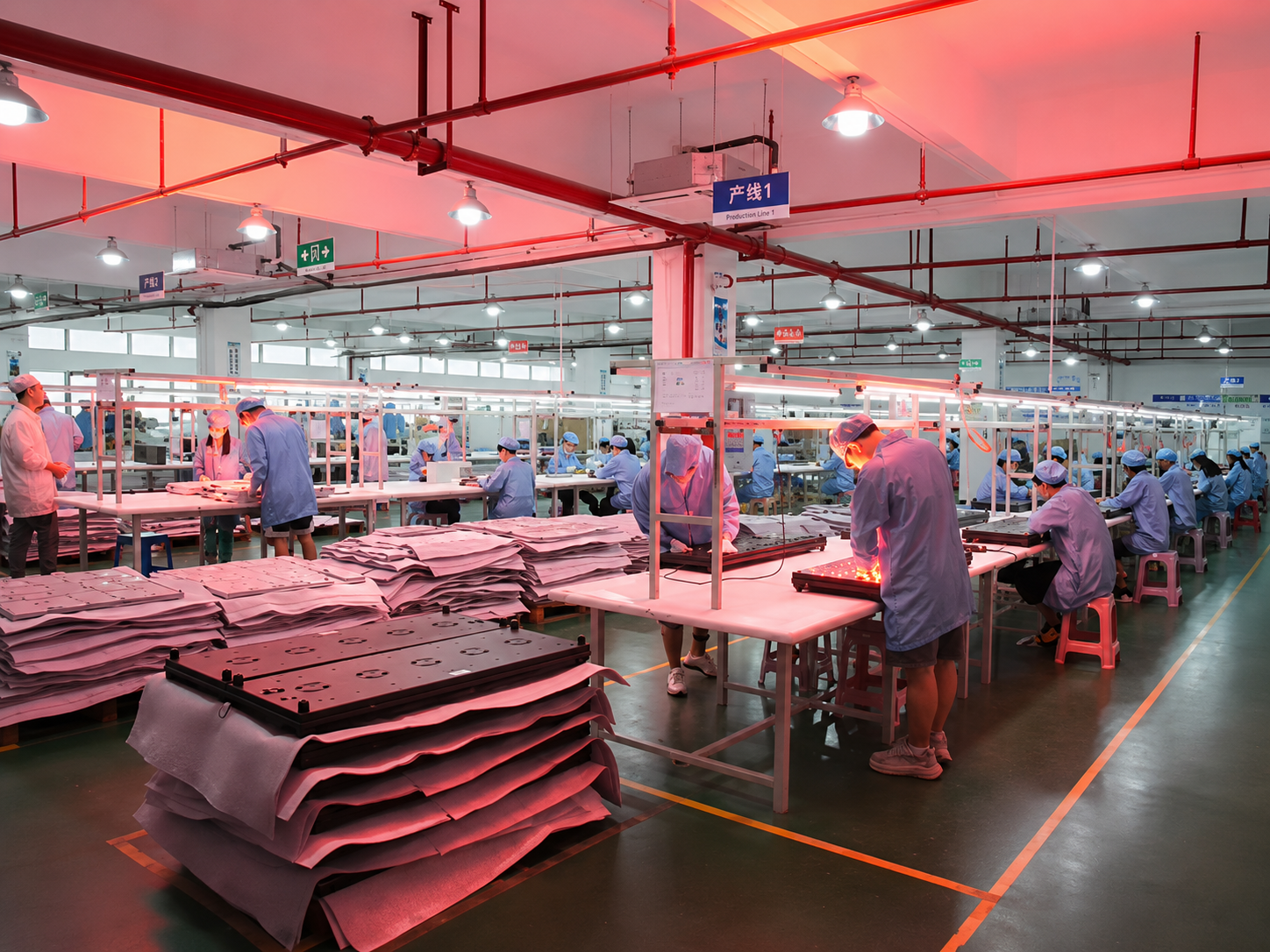
Close-contact products place light sources, wiring and flexible materials near the user for extended sessions. Record surface temperature at multiple locations and intensity settings. Specify the outer material, light-facing layer, padding, seam construction, bend radius and allowable fold pattern.
6. Controller logic and independent zones
Define timers, intensity levels, wavelength selection, pulse settings, memory behavior and automatic shutoff. A two-sided sleeping bag may use one controller, two controllers or independently controlled zones. The manual, labels and accessory list must match the approved electronics.
7. Cleaning and skin-contact instructions
Decide whether the surface is wipe-clean, whether a removable liner is supplied and which cleaners are prohibited. Validate colorfastness, odor, surface damage and electrical performance after repeated cleaning.
8. Electrical and photobiological safety
Request model-specific evidence for the exact power supply, controller and finished configuration. IEC 62471 provides a framework for evaluating photobiological hazards from electrically powered optical sources, including LEDs. Ask a qualified laboratory or regulatory professional to confirm the standards required for the final configuration.
9. Claims and market position
Decide whether the product will be positioned for general wellness or with medical claims. In the United States, FDA guidance distinguishes low-risk general wellness products from products intended to diagnose, cure, mitigate, prevent or treat disease. FDA also states that establishment registration and device listing do not mean that a product is approved, cleared or authorized.
03 — Strategy
Which format fits different brand strategies?
Choose a flat mat for a lower-complexity first launch
A mat usually fits brands that want a broad-coverage product without committing to an enclosed structure. It can be shown on a treatment table, bed or floor and may suit home wellness, studios and recovery programs. The simpler construction can reduce the number of failure points, although the brand still needs to validate folding, connectors, temperature and cleaning.
Choose a sleeping bag for a premium immersive product
A sleeping bag can support a more distinctive full-body ritual and a higher retail position. It also creates more questions: how the two sides are powered, how heat is managed, how the zipper survives repeated use, how the interior is cleaned and how a larger carton affects freight and returns.
Consider a modular product if the market is uncertain
A pair of mats that can operate separately or connect into a wraparound format can give the brand more merchandising options. The concept must still be engineered as a system. Confirm connector protection, control synchronization, fold direction, accessory count and instructions for each permitted configuration.
04 — Validation
How should a buyer test the sample?
Approve the sample against a written checklist rather than a general visual impression. The test should reproduce the intended session, storage, cleaning and handling conditions.
- Measure dimensions, active area, weight and packed carton size.
- Confirm wavelength configuration and controller behavior against the specification sheet.
- Map irradiance at agreed positions using the agreed distance and instrument.
- Record surface temperature during the longest intended session at the highest setting.
- Cycle zippers, connectors, buttons and cables repeatedly.
- Fold and unfold the product using the proposed storage method, then repeat functional checks.
- Run the cleaning protocol several times and inspect seams, odor, color and surface condition.
- Check labels, warnings, manual, accessories, plug and power supply for the destination market.
- Define the golden sample and convert it into production inspection criteria.
05 — RFQ
What should be included in the RFQ?
Send suppliers the same brief so their quotations describe the same product. HSY recommends including:
- Destination market, sales channel and intended wellness or medical positioning
- Mat, sleeping-bag or modular format with finished dimensions and active area
- Wavelengths, ratio, irradiance target and measurement method
- LED layout, zones, timer, intensity, pulse and shutoff requirements
- Material, padding, zipper, cleaning and folding requirements
- Logo, color, labels, packaging, manual languages and accessory list
- Required certificates, reports and production-quality records
- Sample quantity, first order, annual forecast, target cost and launch date
Related HSY resources: Wearables and recovery systems · OEM and ODM capabilities · Quality and compliance
06 — FAQ
Frequently asked questions
Is a red light therapy sleeping bag better than a mat?
Neither format is automatically better. A mat is simpler to use, clean, pack and support. A sleeping bag provides wraparound coverage but requires more complex construction and validation. The better product is the one that fits the target customer, price, claims and operating routine.
What wavelengths should a private-label mat use?
Many products combine red and near-infrared wavelengths, often in ranges around 630 to 660 nm and 810 to 850 nm. The exact selection and ratio should follow the product brief, intended use, evidence strategy and target-market review.
How should irradiance be compared between suppliers?
Compare readings only when distance, instrument, intensity, wavelength mode and measurement positions are stated. Ask for a map across the active area rather than one peak value. Repeat the agreed test on the production sample.
What usually fails first on a flexible light therapy product?
Common risk areas include cable strain relief, connectors, conductors near fold lines, controller buttons, seams, zippers and surface materials exposed to cleaning. A durability plan should cycle these parts before mass production.
Can an FDA registration logo be used as proof of approval?
No. FDA states that establishment registration and device listing do not denote approval, clearance or authorization. Obtain regulatory review before using FDA references in product pages or packaging.
Next step
Plan the product before asking for the lowest price
The mat-versus-sleeping-bag decision changes the bill of materials, test plan, package size, customer routine and after-sales burden. Define those choices before comparing quotations. A detailed brief gives the manufacturer a stable target and gives the buyer a practical basis for sample approval.